Climate Conversations Don’t Have to Start with Climate Change
When I talk to people about my knitting project, I rarely start by talking about climate change.
Usually, they notice the colours first. Sometimes they ask what I'm making. From there, I explain that every row represents a day of average temperature in Kentville, Nova Scotia, and every colour represents a different 3 degree temperature range. Once they understand what they're looking at, the questions tend to come naturally.
These experiences have taught me something about climate communication: sometimes the best way into a conversation about climate change is to start somewhere else.
We don't all start in the same place
There are two common reactions I see when climate change comes up. Some people don't understand the basics well enough to know what we're talking about. Others know enough to understand how enormous and complicated the problem is, and that can be overwhelming.
For decades, a lot of climate communication has leaned heavily on doom and gloom. There is certainly plenty happening that is frightening, but if the problem feels too big, too scary, or too far beyond our control, freezing can feel like a perfectly reasonable response (which, it is!).
I think we sometimes forget that understanding climate change is a process. People study it for years and still aren't experts. We can't expect someone to understand the full context of the climate crisis during a five-minute conversation.
Start with something familiar
I've found that weather, nature and memory can be much better entry points.
Do you remember white Christmases? When did you first hear about or experience a hurricane? What outdoor activities did you do as a kid that you don't do in quite the same way now? Is there a place you loved that has changed or disappeared?
These questions aren't really about testing someone's knowledge. They're invitations to remember. They give people something familiar to think about and then ask what has changed, and why.
I've used childhood memories this way in past engagement work, and I see something similar happen with the blankets. When people can actually see the data, they have something concrete to respond to instead of a giant, abstract problem.
The moment it clicks
One of my favourite examples happened when I had my 1910s and 1980s blankets displayed together.
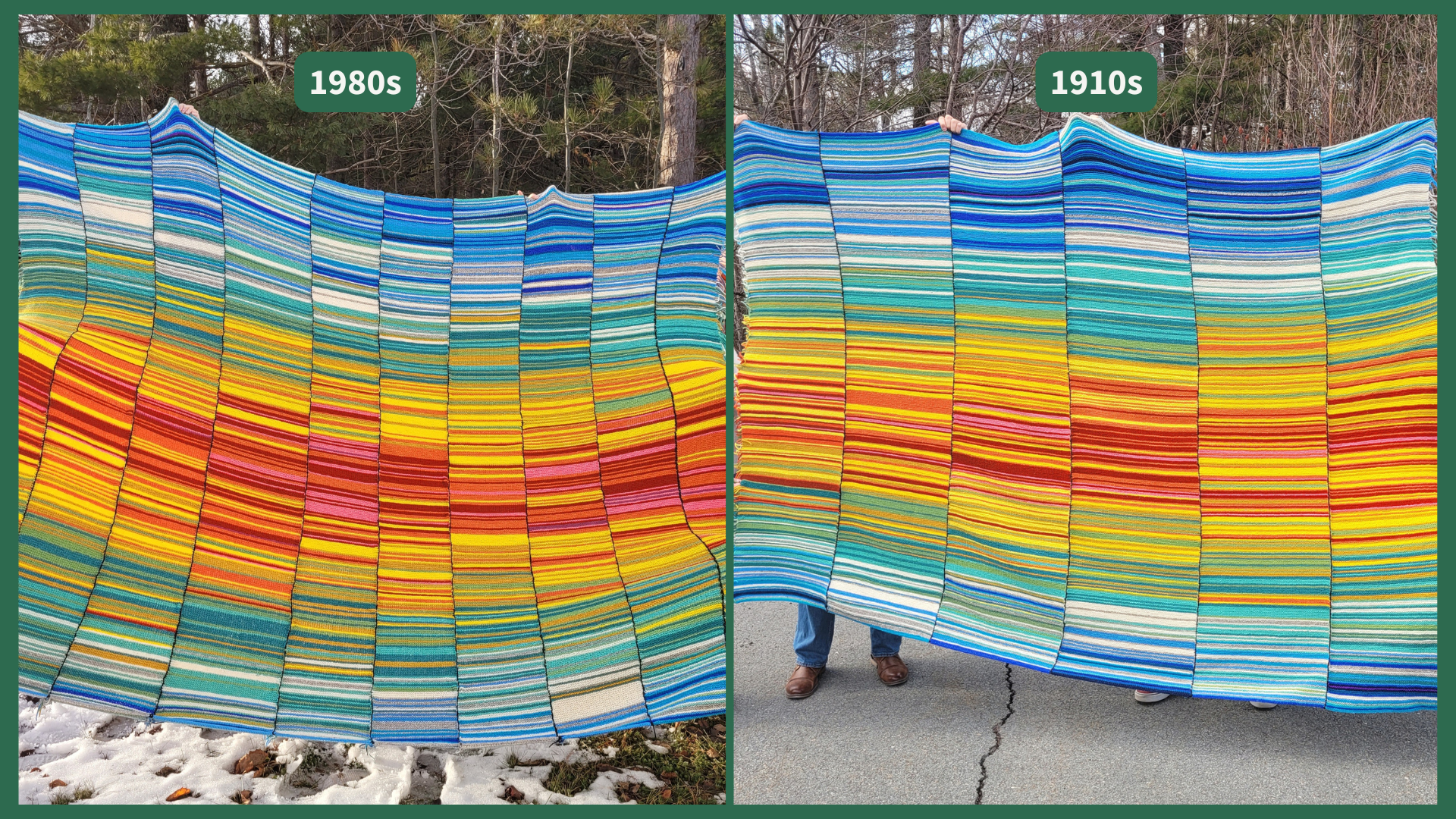
Someone looking at the 1980s asked whether I had noticed differences in the data. I pointed to the 1910s blanket, and you could see the moment it clicked. They could see a distinct difference between the two pieces.
That led to questions about what I was seeing across the larger dataset and whether the patterns showed that climate change is real. Of course, two decades aren't enough to establish a climate trend. But that wasn't the important part. The important part was that they had noticed something themselves.
There is something almost magical about watching that happen. Once people make a connection for themselves, the conversation becomes a two-way exchange. I can share what I know, they can ask questions, and we can build from there.
We don't need to finish the conversation
I don't think every climate conversation needs to end with someone completely understanding climate change, changing their mind, or knowing exactly what they're going to do next.
Sometimes a new perspective is enough. Sometimes it's a question that someone thinks about later. Sometimes it's simply realizing that climate change isn't something happening somewhere else. It's happening around us, too.
So if you're wondering where to start, start small. Start with the backyard tree, the park you love, the food on your table, a childhood memory, or the weather outside your window. Ask what has changed and give people some space to think about it. Then, when the conversation is ready, bring in the science.
Bottomline: We don't have to start with climate change to talk about climate change.
